
DeepCap Pro · Pilot
Foresight
Hold every position to the case you made for it.
Foresight records what you own and why, sets the conditions that would prompt a review, rehearses how the case could fail, and tells you when a condition is reached. Each decision is timestamped and kept, so the record exists before anyone asks for it.
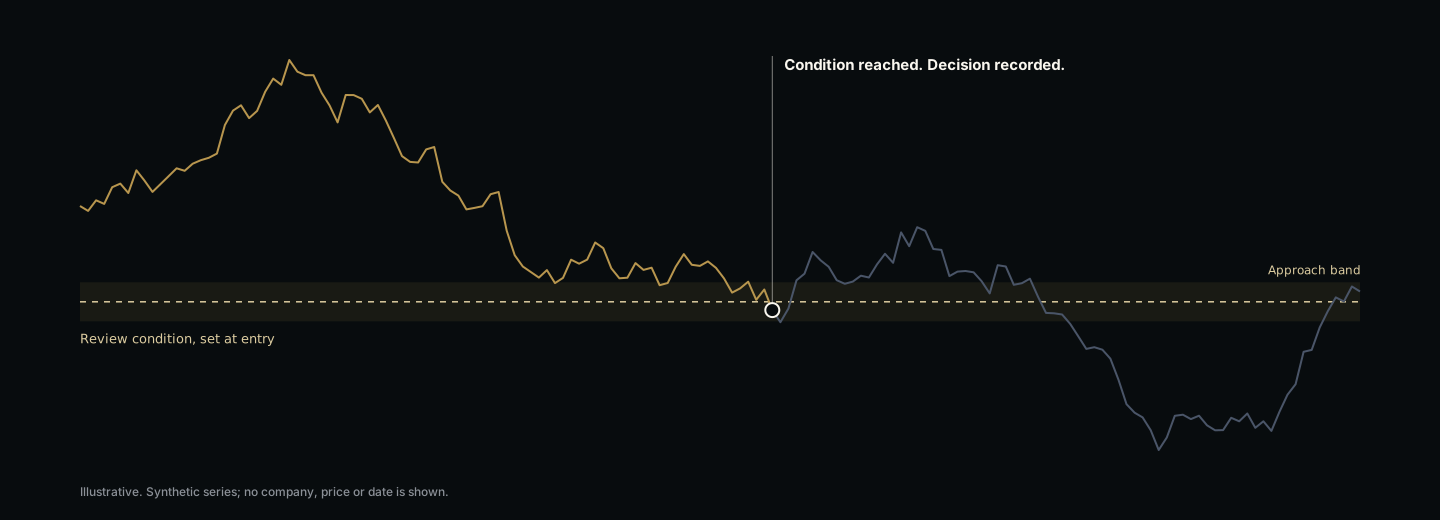
A synthetic price path falls through its approach band and reaches the review condition set at entry; the decision is recorded at that point.
A review condition, set at entry, reached months later
A price path against a condition the holder set in advance, with the approach band and the point at which the decision was recorded.
Source: DeepCap. Synthetic series.
Illustrative. No company, price or date is shown.
Why positions outlive their reasons
An investment case is made once. It is argued in a meeting, written into a memo, and then carried in memory while the position is held. Months later the price has moved, the facts have changed, and the people who made the case are deciding under pressure, with no agreed condition for review and no clean record of what was said at entry.
The costs are familiar. Exits happen late or not at all. Winners are trimmed on instinct. Evidence that contradicts the thesis arrives in filings and on calls and is never tested against it. When a client, a committee or a regulator asks for the reasoning behind a decision, the answer is assembled after the fact.
There is a quieter failure beside these. The case is written for the outcome the team expects. The ways it could fail are rarely listed, the evidence that would show failure early is rarely named, and the response is rarely agreed while the position is calm. So a guidance cut, a rate move or a regulatory decision arrives as a surprise, and the position is resized in the week it happens, on terms set under pressure.
Foresight exists to make the case explicit while it is fresh, to write the failure case beside it, to hold both against what the company reports, and to keep a record that is written as the decisions are made rather than when they are questioned.
What Foresight does
Eight capabilities, in the order you use them.
-
1
Register
A timestamped reason, attached to the position
-
2
Structure
Claims with their provenance, in Thesis Studio
-
3
Set conditions
Armed conditions with their levels and deadlines
-
4
Rehearse the failure
Failure modes, each with a leading indicator
-
5
Evidence and alerts
Claims read intact, softening or broken; an email when a condition is reached
-
6
Decision recorded
An append-only entry, hash-linked to the last
Register the position and the reason
Add a ticker, a weight and the reason you hold it, in your words. The reason is stored with a server timestamp and stays attached to the position for as long as you hold it.
Structure the case in Thesis Studio
Thesis Studio turns your reasoning into claims that a measure can settle. It asks one question at a time, proposes statements for you to affirm or edit, and reads the memos you supply, anchoring each candidate to its source passage. It assembles what you say and writes nothing of its own into the record.
Set the conditions that would prompt a review
A closing price, a market capitalisation, a distance from the 52-week high or a dividend change. Each condition carries its direction, its level and, where you choose, a deadline you committed to in advance.
Rehearse the failure in the pre-mortem lab
Assume the position has failed by a date you choose and work back to the reasons. The lab writes the failure modes from five lenses, clusters them by how often and how severely they recur, and names for each a leading indicator with its metric, source and threshold. The indicators you accept become review conditions Foresight watches.
Stress the case under scenarios
Shock the drivers your claims depend on, such as margins, growth, the multiple, rates or currency, and see the range your own claims imply under each against the current price. The output is a band drawn from your claims, never a target.
Have the evidence tested against the claims
Filings, earnings releases and news are tested against your claims as they arrive. A claim about a reported figure, such as revenue or earnings per share for a stated quarter, is tested against the company's filing. Each claim shows whether it is intact, softening or broken, and every statement links to the passage it came from.
Be told when a condition is reached
Positions are checked against each session's close. When a condition is reached you receive an email that names the position, the condition and the observation that reached it.
Record the decision and keep the record
Exit, trim, hold with the thesis intact, hold with the thesis revised, or snooze. The decision is timestamped, can be amended for a day, and enters an append-only record. A reached condition with no decision is shown as an open exception rather than forgotten.
A daily summary of market conditions (volatility percentile, realised volatility, the share of the book reporting in the next fortnight) and a horizon of dated catalysts sit above the book, so that a reached condition is read in context.
Revenue for the first quarter of FY2027 grows at least 12% on the same quarter a year earlier
- Last test
- 15.6% against your 12.0% floor, tested at the earnings release, passed
- State
- Intact
- Source
- Form 8-K, earnings release: total revenue for the quarter and the same quarter a year earlier
A claim, tested
One illustrative revenue claim on Microsoft, tested against the company's filing: its last test, its state and the source it links to.
Source: DeepCap. A composed frame styled on the Foresight application.
Illustrative values. Not a holding and not a recommendation.
What would tell you, a year from now, that the margin case still holds?
Operating margin holding above 40% while capital spending on data centres keeps rising.
Operating margin stays above 40% through FY2027
Candidate, from your answer. Nothing enters the record until you affirm or edit it.
Affirm EditThesis Studio, one turn
The question, the answer, the candidate statement shown dashed with its affirm and edit controls, and the progress meter.
Source: DeepCap. A composed frame styled on the Foresight application.
Illustrative values. Not a holding and not a recommendation.
The failure case, written in advance
Most investment cases describe the world in which they work. Few describe the world in which they do not, and fewer still say what the team would do there. The result is a position that is sized for the base case and resized in a hurry when the base case breaks. The pre-mortem lab and scenario testing exist for that gap.
The pre-mortem lab
You name the position, a horizon date and the failure you want examined. The lab writes failure retrospectives from five lenses (value discipline, macro and regime, forensic short, credit and balance sheet, systematic), each written without sight of the others, and clusters them by how often and how severely a failure mode recurs. Every ranked failure mode ends in at least one measurable leading indicator, with its metric, its source and its threshold; a run that cannot name one is a failed run. The indicators you accept are promoted into Foresight as review conditions, so the failure case is watched once its indicators are entered. The report carries a limitations panel and no probability, and a pre-mortem is flagged for refresh after 180 days. A pre-mortem can also be run as a facilitated session with the DeepCap research team.
| Rank | Failure mode | Leading indicator and source | Threshold | Status |
|---|---|---|---|---|
| 1 | Azure growth decelerates below the case | Distance from the 52-week high, daily close | More than 25% below the high | Promoted to review condition |
| 2 | Capital spending outruns the return on it | Market capitalisation, daily close | Below US$2.8 trillion | Promoted to review condition |
| 3 | Pricing power in productivity software fades | Dividend per share, as declared | Below US$0.91 a share | Promoted to review condition |
Illustrative values. Not a holding and not a recommendation. Five lenses wrote the retrospectives; the report carries a limitations panel and no probability.
Scenario and stress testing
A thesis rests on a few drivers: a margin, a growth rate, a multiple, a rate, a currency. Scenario testing shocks those drivers one at a time or together and shows the range your own claims imply under each shock, drawn against the current price. The bands come from your claims and from the historical behaviour of the reference set, never from a house forecast, and they carry no probability of the scenario occurring. The point is to see, while the position is calm, which driver the case cannot survive losing.
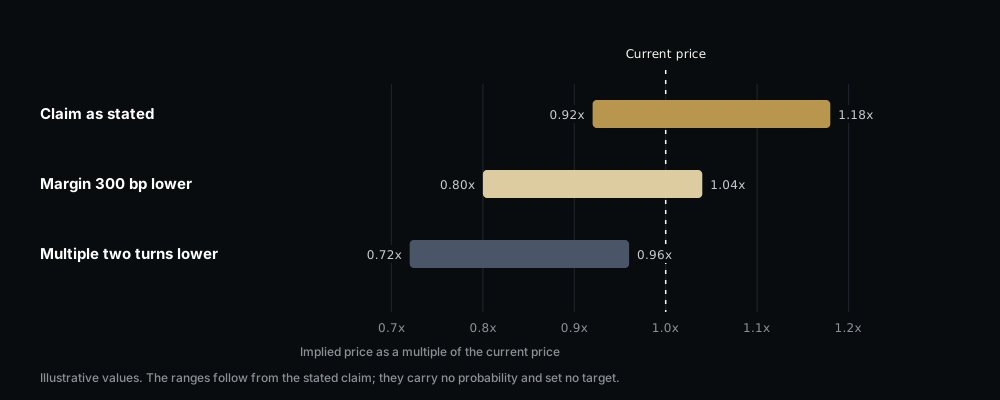
Claim as stated: 0.92x to 1.18x the current price. Margin 300 bp lower: 0.80x to 1.04x. Multiple two turns lower: 0.72x to 0.96x.
A claim under stress
The range a claim implies as stated, and under two shocks to its driver, against the current price.
Source: DeepCap. Synthetic values.
Illustrative values. Bands are drawn from the stated claim; they carry no probability and are never a target.
What the committee sees
A position arrives at the meeting with its reason, its failure modes, the conditions being watched, the evidence tested so far and the decisions taken, in one place.
- 21 April 2026, 21:10 UTC Condition reached Closing price below the review level set at entry hash 9f3c2a
- 22 April 2026, 09:42 UTC Decision recorded Hold with the thesis revised hash 4b81e0
- 22 April 2026, 09:48 UTC Claim revised Azure growth claim restated; the original stays in the chain hash c27d19
- 23 April 2026, 21:30 UTC Claim tested Passed, tested against reported figures hash e05a6b
The decision record
Four consecutive record entries: a condition reached, a decision, a revised claim and a further check, each with its timestamp and the prefix of its chain hash.
Source: DeepCap. A composed frame styled on the Foresight application.
Illustrative values. Not a holding and not a recommendation.
No view of its own
A tool that holds your thesis is only useful if the people who built it have no stake in your conclusion.
- Foresight scores no stocks. It carries no DeepScore and no list, and it ranks nothing. Your positions are held to your criteria.
- DeepCap manages no money and holds no position in any company you register.
- Foresight runs no backtests and publishes no performance figure. There is no track record to sell. The output is the record of your own reasoning and your own decisions.
- Your positions and your reasoning are never an input to DeepCap's research.
- A mutual non-disclosure agreement is signed before any client work begins.
Built as a confidential record
What you write into Foresight is the most sensitive material an investment firm holds. The design treats it that way.
Encrypted before it is stored
The text of your rationale, claims, thresholds, decision notes, weights and documents is encrypted with AES-256-GCM before it reaches the database, under a key held for your account. The value observed at each check and its distance from the threshold are encrypted the same way. The outcome of each check, and a coarse band for its distance from the threshold, are stored in plain text; read against public prices, they narrow the range in which a threshold lies. The encrypted text is never searched or sorted in plain text.
A record that cannot be edited in place
Every entry is appended and hash-linked to the one before it. A revised claim is marked as revised and the original stays in the chain.
Two-factor sign-in
Two-factor sign-in with an authenticator app, email codes or backup codes is available on every account.
Retention
Records are retained for the period agreed in your contract and erased at its end in the manner set out in your contract.
Data handling
The handling of your data, including any processors involved, is set out in the pilot agreement.
| Field | How it is stored |
|---|---|
| Rationale | Encrypted before storage |
| Claims | Encrypted before storage |
| Thesis text | Encrypted before storage |
| Thresholds | Encrypted before storage |
| Condition deadlines | Encrypted before storage; the time an expiry is recorded shows the date |
| Decision notes | Encrypted before storage |
| Weights and holdings | Encrypted before storage |
| Documents | Encrypted before storage |
| Observed value at each check | Encrypted before storage |
| Distance from each threshold | Encrypted before storage |
| Ticker | Plain text, for sorting |
| Book id | Plain text, for sorting |
| Level | Derived when read and never stored |
| State | Plain text, for sorting |
| Severity | Plain text, for sorting |
| Timestamps | Plain text, for sorting |
| Distance bucket | Plain text |
| Outcome of each check | Plain text, for alerts |
Available to test now
Foresight is available for pilot use. A pilot runs on your own names and the conditions you would actually set, inside your own account. The conditions and the measures they can be set on can be adjusted to fit your process. The pilot is where we find out what your committee needs to see.
What Foresight does not do
- Foresight makes no recommendations and sets no price targets.
- Profit and loss is reported by your custodian. Foresight does not compute it.
- Foresight does not trade, and does not connect to a broker or custodian.